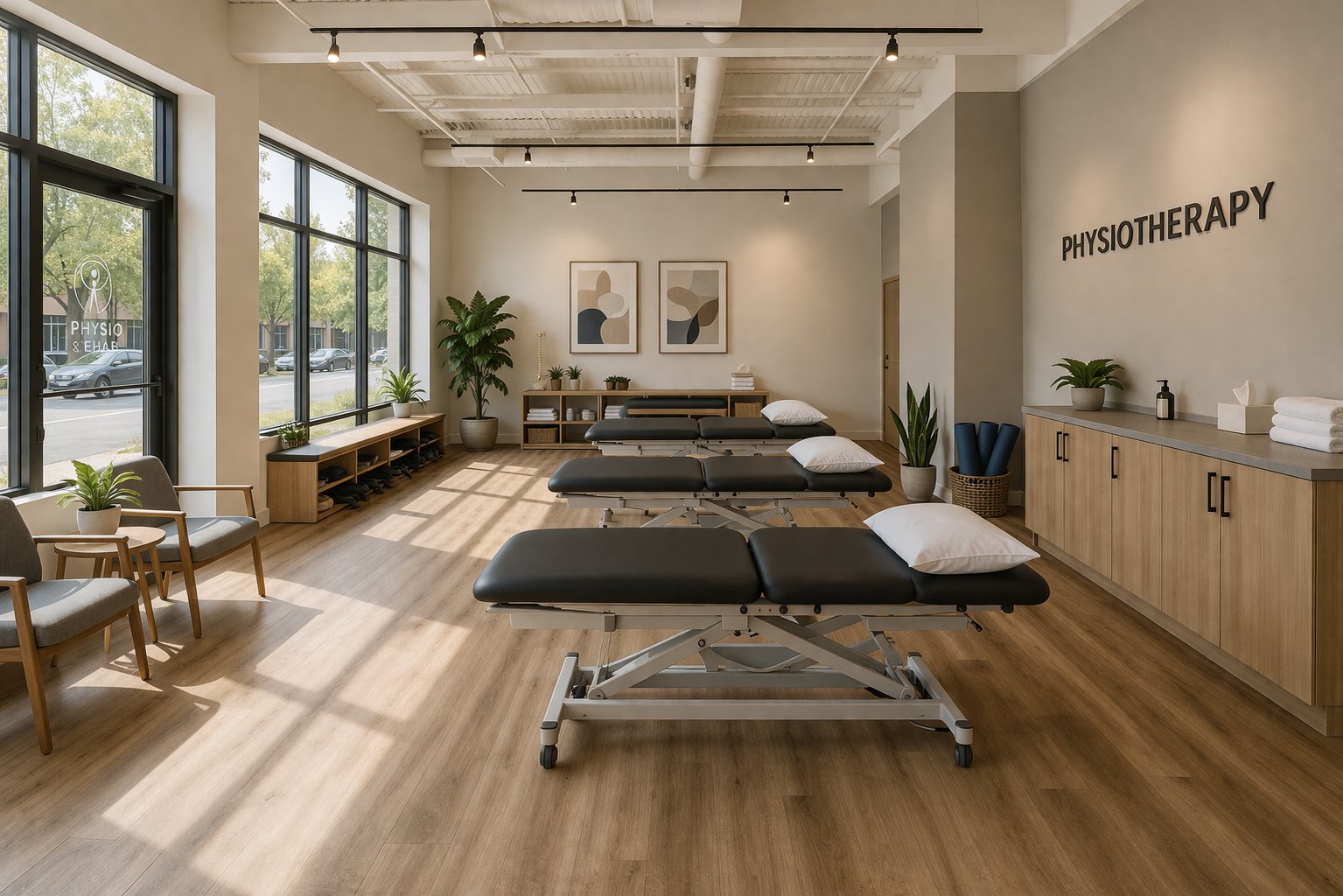
Most physiotherapists, registered massage therapists, and rehab founders who reach out to us are opening their first clinic. They know exactly how to treat patients, but they have never negotiated a commercial lease, and the decisions they make in the first few weeks of a space search (which unit, what rent, what terms) set the clinic's costs for the next five to ten years. This guide walks through the process in the order it actually happens, so you can move quickly without signing something you will regret.
Step 1: Define the Clinic Before You Look at Space
Start with the clinical model, not a listing. Write down how many practitioners will treat at the same time in year one and in year three, which disciplines you plan to offer, and how patients move through a visit. That gives you a room program:
- Treatment rooms: one per practitioner treating at the same time, plus one spare if you expect to grow. Physiotherapy and massage rooms commonly run 80 to 120 square feet each.
- Open exercise or gym area: for active rehab, often 300 to 800 square feet depending on equipment and class size.
- Reception and waiting: sized to your busiest hour, with room for mobility aids.
- Support space: at least one accessible washroom, laundry and linen storage, a staff area, and equipment storage.
- Multidisciplinary extras: occupational therapy and speech-language pathology need quiet, sound-separated rooms, and paediatric programs may need higher ceilings or a larger open area.
As a rough guide, a first clinic with three to five treatment rooms and a small gym lands between 1,000 and 2,500 square feet. A solo practitioner or RMT can often start well under 1,000 square feet.
Step 2: Build a Real Monthly Budget
The most common first-clinic mistake is shortlisting space on the advertised net rent alone. Commercial space is usually quoted per square foot per year, and the net rent is only part of the cost. Your all-in occupancy cost includes:
- Net (base) rent per square foot per year.
- Additional rent, often called TMI or CAM: your share of property taxes, building maintenance, and insurance.
- Utilities, if separately metered.
- HST on rent and additional rent.
For example, a 1,500 square foot unit at $28 net plus $14 additional rent works out to $42 per square foot, or about $5,250 a month before utilities and HST. Ask for the current year's additional rent estimate before you get attached to a unit. Our guide to net versus gross rent explains how to compare quotes that are structured differently.
Then add the build-out. A raw shell needs walls, plumbing, HVAC adjustments, flooring, lighting, and accessibility work, which is why the tenant improvement allowance and the rent-free fixturing period are often worth more than a dollar off the rent.
Step 3: Choose the Location for Patients and Referrals
For physiotherapy and rehab, the best site is usually not the most prestigious one. What matters most:
- Ground floor and barrier-free access. Post-surgical and mobility-limited patients should not depend on an elevator.
- Free, close parking for patients, plus accessible spaces near the entrance.
- Referral proximity. Plazas and medical buildings with family physicians, walk-in clinics, orthopaedic or sports medicine practices, and pharmacies feed a physio clinic.
- Visibility and signage for self-referred and motor vehicle accident patients.
- Fit with your patient base: commuter corridors for working adults, family neighbourhoods for paediatrics, and seniors' areas for falls prevention and post-operative rehab.
Second-generation clinic space (a unit previously built out for a medical, dental, or wellness tenant) can save months and a significant share of construction cost, because washrooms, plumbing, and room walls may already be in place.
Step 4: Confirm the Space Can Legally and Physically Work
Before you sign anything binding, confirm:
- Zoning and permitted use allow a health clinic at the address, and the lease's use clause covers every service you plan to offer, including future disciplines.
- No existing exclusive held by another tenant blocks physiotherapy, massage, or chiropractic in the plaza, and ask whether the landlord will grant you an exclusive.
- Floor loading, electrical, and HVAC can handle your equipment and treatment rooms, especially for heavier gym equipment, hydrotherapy, or shockwave and laser devices.
- Accessible washroom and path of travel are in place or can be built within budget.
Have a contractor or designer walk the unit before you waive conditions. Our allied health leasing guide covers space programming in more detail.
Step 5: Negotiate the Offer to Lease, Not Just the Rent
Most of the long-term cost is set in the offer to lease (or letter of intent), long before the formal lease arrives. First-time clinic owners most often overlook:
- Term and renewal options. A five-year term with one or two five-year renewal options protects the patient base you are about to build. Without a renewal option you have far less leverage later.
- Fixturing period long enough to complete construction before rent starts.
- Personal guarantee. Landlords usually ask a new business owner for one. Its amount, duration, and whether it reduces over time are negotiable.
- Assignment rights so you can sell the clinic or bring in a partner without the landlord unreasonably refusing consent.
- Restoration obligations at the end of the term, so you are not paying to remove your own improvements.
- Signage and after-hours HVAC, since many clinics open early and stay late.
Have a lawyer review the lease before you sign. This guide is general information, not legal or tax advice.
A Realistic Timeline
From the first property tour to seeing patients, most first clinics take four to eight months:
- Weeks 1 to 8: define the program, set the budget, tour, and shortlist.
- Weeks 4 to 12: negotiate the offer to lease, complete due diligence, and finalize the lease.
- Months 3 to 7: design, permits, construction, and inspections.
- Final weeks: furniture, equipment, signage, and opening.
If you need to open within 30 days, focus on second-generation clinic space that needs only cosmetic work, and expect fewer options and less room to negotiate.
How PRAXIS Helps
PRAXIS Healthcare Real Estate, a division of Lucero Commercial Group, represents physiotherapists, massage therapists, and multidisciplinary rehab founders searching for their first clinic across Ontario and Alberta, including the GTA, York, Durham, Halton, Calgary, and Edmonton. Led by Mya Qi, MPH, we build the room program and budget with you, search on and off market, and negotiate the offer to lease so the terms fit a growing practice. See our tenant representation service or tell us about your clinic.
Frequently asked
Most first clinics with three to five treatment rooms, a small open exercise area, reception, a washroom, and storage fit in roughly 1,000 to 2,500 square feet. A solo practitioner or RMT can often start in 600 to 1,000 square feet, while a multidisciplinary clinic with OT, speech-language pathology, and a larger gym usually needs 2,500 square feet or more.
Plan on roughly four to eight months from the start of a space search to seeing patients. Finding a suitable unit and negotiating the offer to lease often takes one to three months, and design, permits, and build-out usually take another two to four months. Second-generation clinic space that needs only cosmetic work can shorten the timeline considerably.
Commercial clinic space is usually quoted as a net rent per square foot per year, plus additional rent (taxes, maintenance, and insurance, often called TMI), plus utilities. To estimate the monthly cost, add the net rent and additional rent per square foot, multiply by the size of the unit, and divide by 12. A 1,500 square foot unit at $28 net plus $14 additional rent costs about $5,250 a month before utilities and HST.
You are not required to have one, but the landlord's agent works for the landlord. A tenant representative works for you on site selection, comparing terms, and negotiating the offer to lease, which is where most long-term costs are set. In most lease transactions the tenant's representation is paid through the landlord's co-operating commission.
Ground floor is strongly preferred. Many physiotherapy patients arrive with mobility limitations, post-surgical restrictions, or crutches, so a barrier-free entrance, close accessible parking, and no reliance on an elevator make a real difference to patient experience and retention.